Road safety

One hundred and seventy-seven thousand, in one year

The Ministry of Road Transport and Highways recorded 1,72,890 deaths on Indian roads in 2023 — large enough to stop meaning anything, so: someone dies on an Indian road roughly every three minutes, and two in three of them are between 18 and 45.

We publish this page because we teach against it. A training company that quotes safety without quoting the evidence is selling something — every figure below is sourced, and the note at the foot says from where and when it was last checked.

The figures

1,72,890Road accident deaths in India in 2023
68%Of those deaths caused by over-speeding
Two in threeVictims aged 18–45 — the most productive years
44.8%Of those killed were two-wheeler riders
Every 3 minutesSomeone dies on an Indian road
3–5%Of India's GDP lost to road crashes (World Bank)
Why it happens

Five causes, and only one of them is the road

Infrastructure is the government's to fix. The other four are within reach of the person holding the wheel — which is the entire argument for training.

01

Lack of Professional Training

A vast majority of Indian drivers learn to drive informally – from friends, family, or unlicensed instructors. Without structured training in traffic rules, defensive driving, and emergency response, these drivers are ill-equipped to handle the complexities of Indian roads.

02

Overspeeding

Speed is the single biggest killer on Indian roads. The faster a vehicle travels, the longer it takes to stop and the greater the impact in a collision. Over-speeding was behind 68% of all road accident deaths in 2023. Fines under the Motor Vehicles (Amendment) Act, 2019 run from ₹1,000 to ₹4,000 depending on the vehicle class.

03

Drunk Driving

Alcohol impairs judgement, reaction time and coordination, and drunken driving remains among the causes MoRTH records separately in its annual review of road accidents. Penalties under the Motor Vehicles (Amendment) Act, 2019 include a fine of up to ₹10,000 and imprisonment for up to six months.

04

Ignoring Safety Equipment

Not wearing seatbelts, not using helmets, and not securing children in appropriate car seats contribute significantly to fatality rates. In 2024 alone, non-use of helmets was recorded in over 54,000 deaths and non-use of seatbelts in over 14,000. The seatbelt requirement under the Motor Vehicles (Amendment) Act, 2019 applies to rear-seat passengers too.

05

Poor Road Infrastructure

Missing road signs, inadequate lighting, lack of lane markings, poorly designed intersections, and absence of pedestrian crossings all contribute to accident risk. While infrastructure improvement is a government responsibility, trained drivers are better equipped to navigate these challenges safely.

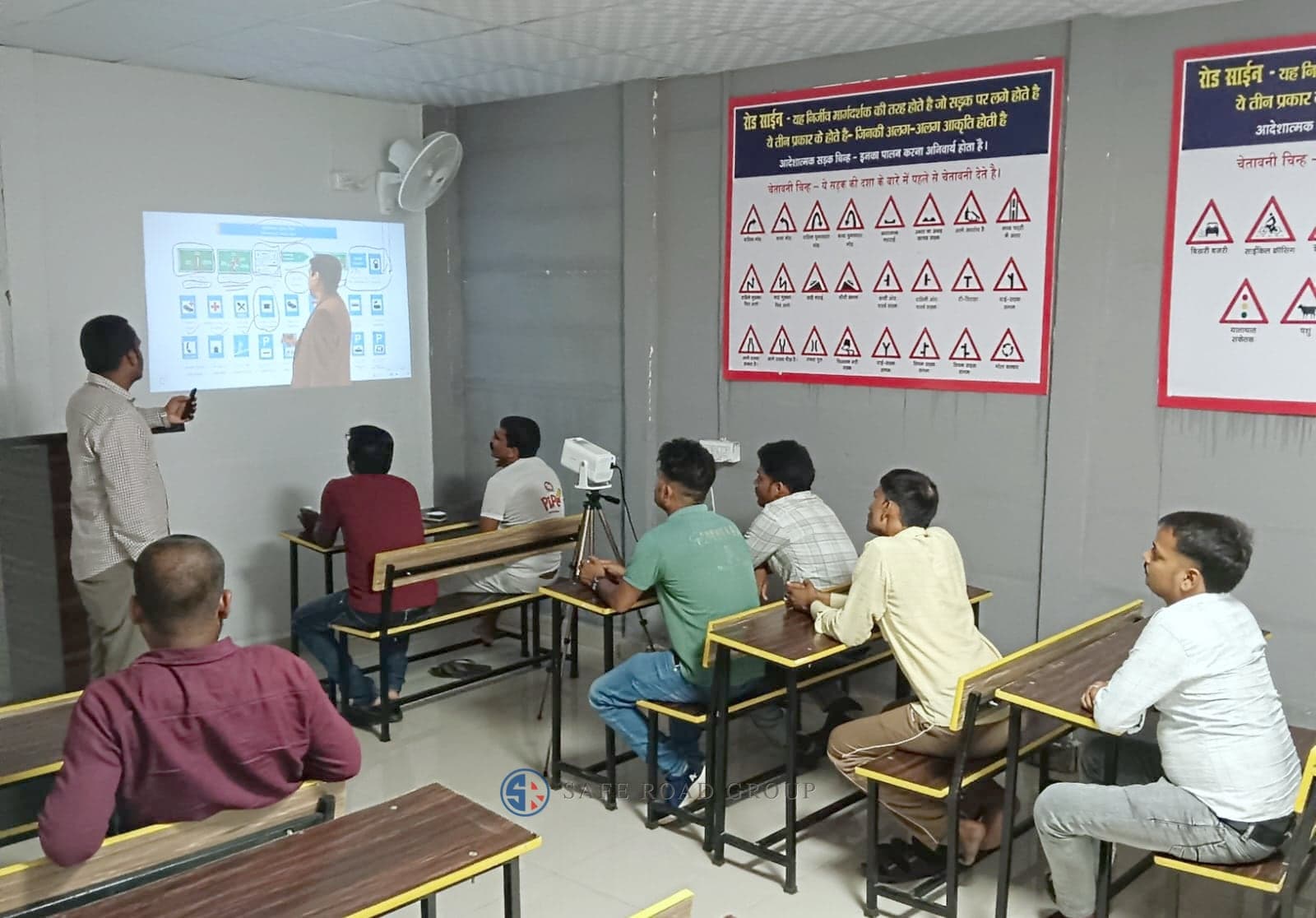
Most Indian drivers were never taught. They were shown.

A cousin in a field, an uncle on a quiet road, a fortnight with an unlicensed instructor and a test that asks very little. It produces people who can operate a vehicle and have never been taught to read a road. That is not a character failing; it is a training gap, and it is the one this company exists to close.

A theory class in session, with the road sign charts on the wall behind
The signs on the wall behind are the same ones set out below. A driver who has sat through this knows them before the test asks.
What training changes

Five things a trained driver has that an untrained one does not

01

Hazard Perception

The ability to anticipate dangers before they materialise – a skill that can only be developed through systematic training.

02

Defensive Driving

Techniques to protect yourself from other drivers' mistakes – maintaining safe following distances, scanning intersections, and managing blind spots.

03

Emergency Response

Knowing what to do when things go wrong – emergency braking, skid recovery, and evasive manoeuvres.

04

Traffic Law Knowledge

Understanding and respecting traffic rules is the foundation of safe driving. Trained drivers know the rules; untrained drivers guess at them.

05

Vehicle Mechanics

Pre-trip inspections, tyre condition assessment, brake checks – skills that prevent mechanical failures from becoming fatal accidents.

The law

Penalties under the Motor Vehicles (Amendment) Act, 2019

States notify their own compounding amounts, so the figure collected locally may differ from the one prescribed.

ViolationFirst offenceRepeatAlso
Driving without licence₹5,000₹10,000Vehicle seizure
Overspeeding₹1,000-4,000₹2,000-8,000Licence suspension
Drunk driving₹10,000₹15,0006 months imprisonment
Not wearing seatbelt₹1,000₹2,000Applicable to all seats
Not wearing helmet₹1,000₹2,0003-month licence suspension
Using mobile phone₹1,000-5,000₹10,000Licence suspension possible
Jumping red light₹1,000-5,000₹10,000Licence suspension possible
Driving without insurance₹2,000₹4,000Vehicle impoundment
Driving without PUC₹10,000₹10,000Vehicle may be seized
Dangerous/reckless driving₹1,000-5,000Up to ₹10,0006 months to 1 year jail
Reading the road

Three shapes, and two colours

A sign is legible as a shape long before it is legible as a picture, and the colour of a line on the road carries as much instruction as the line itself.

The shape of a sign is legible long before the picture on it is. So learn the shape first — a circle commands, a triangle warns, a rectangle informs. On the road surface itself, colour does the same work.

Mandatory / Regulatory

Circular. Disobeying one is a legal offence. STOP and GIVE WAY are the two exceptions to the shape.

Cautionary / Warning

Triangular. It tells you what is coming, early enough to react and manoeuvre.

Informatory / Guide

Rectangular. Direction, distance, facility — information, not instruction.

Yellow — restriction

The centre line between two directions: you may not cross into the other side's lane. No-parking and no-stopping areas are yellow too.

White — instructive

The arrows that say which way to drive, and the edge lines you cross only to stop in an emergency. Not as restrictive as yellow.

Sources — Training Manual for Drivers; IRC:67-2012 (road signs) and IRC:35-2015 (road markings); section 116 of the Motor Vehicles Act, 1988.

Speed

Limits by road class

Indicative maxima. The limit that applies on any stretch is the one on the sign, and States and local authorities notify their own — a lower posted limit always governs.

RoadCarsTwo-wheelersHeavy vehicles
Expressways120 km/hNot allowed80 km/h
National Highways100 km/h80 km/h60-80 km/h
State Highways80 km/h60 km/h60 km/h
City / Urban Roads50 km/h40 km/h40 km/h
Before you leave this page

Seven things, none of which cost anything

The last one is the only one we are selling, and we have put it last deliberately. The other six are worth more than anything on this site.

  1. 01Always wear your seatbelt and ensure all passengers do the same (including rear seat)
  2. 02Never drive under the influence of alcohol or drugs
  3. 03Respect speed limits, especially near schools, hospitals, and residential areas
  4. 04Never use your mobile phone while driving – not even at traffic signals
  5. 05Keep your vehicle well-maintained with regular servicing and tyre checks
  6. 06Set a good example for the next generation of drivers
  7. 07Get professionally trained at an accredited centre — even if you already know how to drive

Run a road safety session at your depot or school

We run one-day defensive driving and road safety sessions for fleets, and awareness work with schools and district administrations across eastern Uttar Pradesh. Tell us the audience and we will tell you what a useful session looks like.

Accident figures on this page are from the Ministry of Road Transport and Highways, Road Accidents in India 2023. The economic cost of road crashes is the World Bank’s estimate. Penalties are those prescribed under the Motor Vehicles (Amendment) Act, 2019; States notify their own compounding amounts. Reviewed September 2026.